Shared, local-first memory for coding agents
One memory across your coding agents. Plain Markdown under your control.
agentcairn captures durable context across Claude Code, Codex, Cursor, OpenCode, and more into an Obsidian-compatible vault. A rebuildable DuckDB index gives fast hybrid recall; hand-edit a fact and the agents honor it.
$ claude plugin marketplace add ccf/agentcairn
$ claude plugin install agentcairn@agentcairnVault · source of truth
---
tags: [auth, fix]
---
Fixed login by rotating
[[jwt-secret]] during [[deploy]].
Index · disposable cache
MCP · recall
cairn recall "how did we fix login?"
Rotated the jwt-secret during deploy.
↳ auth-fix.md
The contract
The files are canonical. The index is replaceable.
Some memory systems center a managed database; other local-first tools also use editable files. agentcairn's contract is specific: your Markdown vault is canonical, DuckDB is a disposable retrieval cache, and every supported coding agent shares the same memory.
It is purpose-built for coding workflows: ambient multi-harness capture, project and harness provenance, secret-aware ingestion, temporal supersession, and reproducible retrieval benchmarks.
Six differentiators
Obsidian Vault is the source of truth
Human-readable Markdown with frontmatter and [[wikilinks]]. Edit it by hand; the index honors your edits.
The index is disposable
DuckDB is a rebuildable cache. cairn reindex restores everything — zero data loss.
Non-lossy by construction
The full note is always retained. Distillation only adds derived notes that link back.
Redaction before every write
Secrets scrubbed (regex + entropy + URL-cred) before body, title, or tags reach the vault.
A free, deterministic graph
Your [[wikilinks]] are the graph — no LLM extraction, no hallucinated entities.
Daemonless, zero external DB
One embedded DuckDB does vector + BM25 + graph. No server, no Neo4j/Postgres/Qdrant.
How it works
Capture reads your agent's session transcripts out-of-band, then redacts → dedups → importance-gates → distills into the vault. Retrieval fuses BM25 + vectors with RRF, with an optional cross-encoder reranker. The disposable index reconciles before the first MCP read, and remember writes through immediately; the server exposes remember · recall · search · build_context · recent.
Survives uninstall
Delete the index. Reindex. Everything's back.
The index is a cache. The proof is destructive: remove it, rebuild it, lose nothing — because the truth was never in the database.
Benchmarks measured
Retrieval — LoCoMo
| arm | r@5 | r@10 | MRR |
|---|---|---|---|
| BM25 only | 0.527 | 0.604 | 0.459 |
| vector only | 0.536 | 0.637 | 0.433 |
| hybrid (RRF) | 0.562 | 0.648 | 0.477 |
| hybrid + reranker | 0.662 | 0.735 | 0.608 |
LoCoMo retrieval, turn-level macro-avg, FastEmbed nomic-embed-text-v1.5 (the default).
Retrieval — LongMemEval-S
| arm | session r@5 | session MRR | turn r@5 |
|---|---|---|---|
| BM25 only | 0.920 | 0.918 | 0.680 |
| vector only | 0.936 | 0.916 | 0.507 |
| hybrid (RRF) | 0.954 | 0.938 | 0.640 |
| hybrid + reranker | 0.969 | 0.963 | 0.788 |
LongMemEval-S, full 500-instance set. Full turn r@10/MRR in the README.
Context efficiency
| dataset | haystack | recalled | reduction |
|---|---|---|---|
| LoCoMo | 25,646 tok | 529 tok | 51.1× |
| LongMemEval-S | 136,552 tok | 2,207 tok | 64.7× |
Context the default config recalls vs the full history. Estimate (~4 chars/tok).
- No single headline number — these are relative ablation signals.
- graph-boost is inert on chat corpora (no native wikilink graph); it's for real vaults.
- QA-accuracy numbers use an Anthropic judge, not GPT-4o — not comparable to published leaderboards.
Quickstart
# Claude Code plugin (recommended)
claude plugin marketplace add ccf/agentcairn
claude plugin install agentcairn@agentcairn

# Codex plugin
codex plugin marketplace add ccf/agentcairn
codex plugin add agentcairn@agentcairn

# ...or use it directly — standalone CLI + MCP server
uv tool install agentcairn          # installs the cairn + agentcairn commands
uvx agentcairn                      # ...or run the MCP server ephemerally
cairn install cursor                # wire the server into another host
cairn recall "how did we fix auth?"  # hybrid recall
cairn savings                       # context recall has saved you
cairn doctor                        # health-check the index
Use it in any MCP host
First-class in Claude Code, Codex, OpenCode, Hermes, and Antigravity. Portable everywhere else.
Claude Code, Codex, and Antigravity get a first-class plugin — a bundled MCP server, a memory skill, and (on Claude Code and Codex) ambient session hooks (recall at session start, capture at session end). Antigravity has no plugin hooks, so capture runs out-of-band via cairn sweep. Every other MCP host gets the same recall/search/remember tools via the portable server; cairn install wires it in non-destructively (your other servers are preserved, the original backed up to <config>.bak). Hermes Agent gets a native agentcairn MemoryProvider, and the agentcairn-obsidian plugin lets you read and navigate that memory inside Obsidian. One global ~/agentcairn vault, shared across every host.
| host | support | set up with | ambient |
|---|---|---|---|
| Claude Code | Plugin | cairn install claude-code | ✓ |
| Codex | Plugin | cairn install codex | ◐ |
| Cursor | MCP server + skill + ingest | cairn install cursor | ◐ |
| OpenCode | Plugin + MCP + ingest | cairn install opencode | ✓ |
| Hermes Agent | MemoryProvider plugin | see integrations/hermes/ | ✓ |
| Antigravity | Plugin + ingest | cairn install antigravity | ◐ |
| VS Code (Copilot) | MCP server | cairn install vscode | — |
| Claude Desktop | MCP server | cairn install claude-desktop | — |
cairn install                 # detect installed agents + preview (writes nothing)
cairn install codex           # install the Codex plugin (shells to `codex plugin …`)
cairn install cursor          # write MCP config for an MCP host
cairn install --all           # configure every detected agent
Plugin hosts (Claude Code, Codex, Antigravity) install via the host's own CLI — the MCP server is bundled in the plugin. MCP hosts take a JSON mcpServers entry (VS Code uses its servers key), written non-destructively, idempotent, backup-first. Ambient recall-at-start + capture-at-end is fully wired on Claude Code; on Codex the hooks ship and capture also runs out-of-band via `cairn sweep`, with live recall-at-start being verified. Antigravity has no recognized plugin hooks — capture runs out-of-band via `cairn sweep` (◐). `agy plugin install` takes a local directory (not a git repo), so install with `cairn install antigravity --source <plugin dir>`; it also removes any stale mcp_config.json entry. Cursor has no plugin hooks either — `cairn sweep` ingests sessions out-of-band from Cursor's global `state.vscdb` SQLite store (`cursorDiskKV` user bubbles); Cursor remains an MCP host (not a plugin host), but `cairn install cursor` also installs the `using-agentcairn-memory` skill to `~/.cursor/skills/` alongside writing `~/.cursor/mcp.json`.
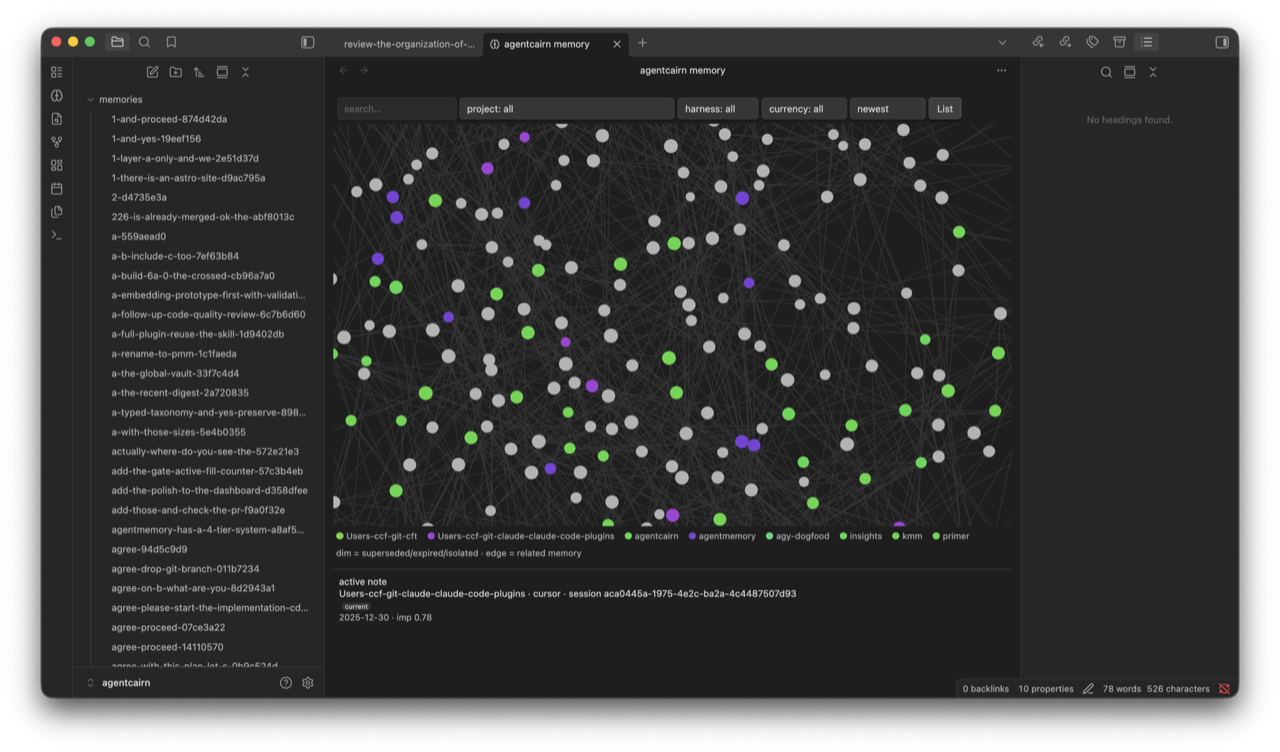
Because the vault is plain Markdown, you can read what every agent remembers in Obsidian: the agentcairn-obsidian plugin (on the community store) adds a vault-native Memory view — a filterable list with provenance and currency, plus a d3-force memory graph of related: links, colored by project and sized by importance.
Trust & security
Redaction before write
regex + entropy + URL-credential
No network listener
stdio MCP; short-lived read-only query handles
No telemetry
nothing phones home
Index outside the vault
the .duckdb cache is never synced